Coffee Is a Fruit. You've Been Ignoring That.
Share
Let me ask you something.
Is the corn you grow in your garden better than the corn at the grocery store?
Probably, right? Different soil. No pesticides. You’re paying attention to it. And if an ear doesn’t turn out, you throw it instead of just mixing it in.
Coffee works the same way. And almost nobody treats it like that.
What Coffee Actually Is
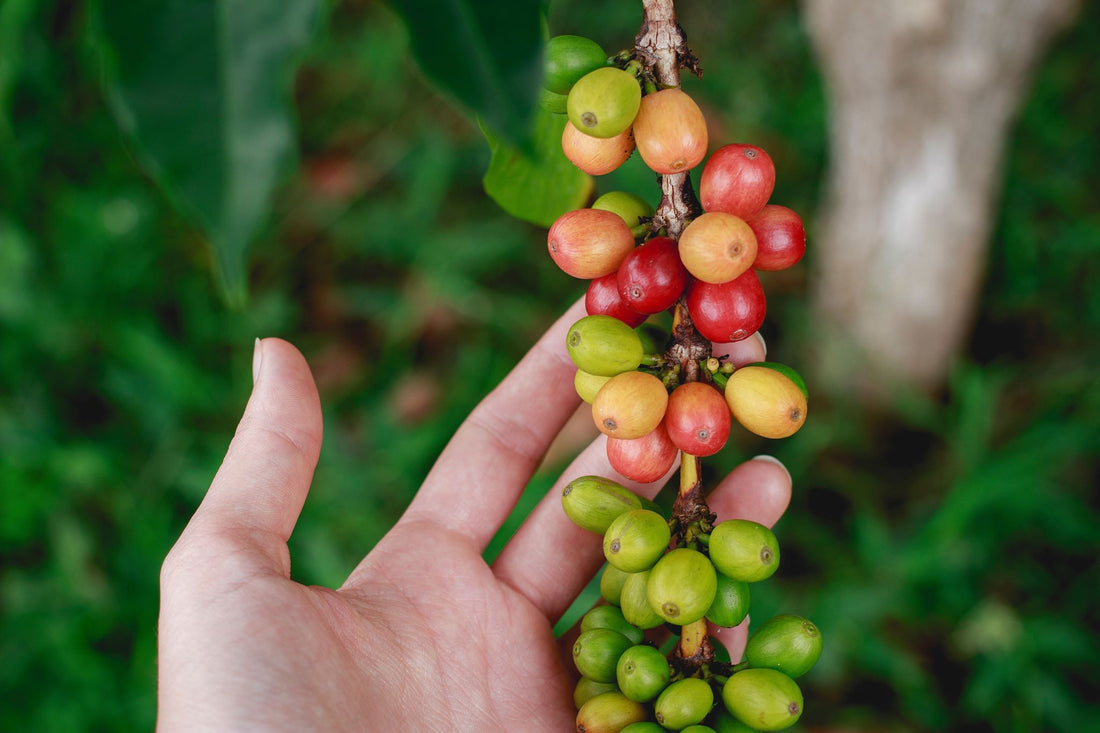
Coffee is the seed of a cherry — the coffea plant. When the cherry ripens, it turns red. You pick it. Inside the cherry, under several layers of fruit and a sticky film, is the bean.
That bean is what ends up in your cup.
It grows only in a narrow band around the equator — between the Tropics of Cancer and Capricorn, roughly 20 degrees off center. It needs warmth, a bit of dryness, and elevation. Coffee is mountain-grown. The terroir matters the way it matters for wine, except coffee has about ten times more volatile aromatic compounds. Ten times more potential for flavor variety than wine.
Most people have no idea.
Two Coffees, Two Very Different Things
Of the 129 identified coffee species, two matter commercially: Arabica and Robusta.
Arabica is the higher-quality one — sweeter, brighter, more complex, more susceptible to disease. Lower caffeine by volume. Harder to grow. Worth more.
Robusta is hardier, cheaper, more aggressive in flavor, and higher in caffeine. Double the caffeine of Arabica, roughly. It’s what goes into instant coffee and some espresso blends. We use it in exactly one of our coffees — Tenebrae, our darkest roast, because Robusta suits espresso and the name suits the coffee. But that’s a story for another post.
For everything else, we focus on Arabica.
Commodity vs. Specialty: The Difference That Actually Matters
Here’s where most coffee education stops: it’s just Arabica. As if all Arabica is the same. It isn’t.
There are two markets for coffee. One is commodity — the big pot. Entire growing regions blended together, mass-marketed, graded by weight and volume, not by flavor. This is Juan Valdez. This is what most of the world drinks.
The other is specialty. Specialty coffee is bagged and freighted specifically to importers and roasters because of its quality. It has a farm name, often a farmer’s name, sometimes a specific processing lot. The importer tasted it at origin before it ever went in a container. It was graded. It passed.
I want to know where my coffee came from. I want to know about the farmer. I want to know how it was processed and that the quality was preserved all the way to my door.
That’s what specialty coffee is.
Why It Tastes Different
Think about those volatile aromatics — all those flavor compounds that coffee has in abundance compared to wine. They’re fragile. They come from the fruit. They’re affected by how ripe the cherry was when picked, how it was processed, how it was dried, how it was stored, and how it was roasted.
Commodity coffee doesn’t protect those compounds at every step. It can’t — the economics don’t work when you’re blending hundreds of farms into one container.
Specialty coffee is designed around them.
When you taste a single-origin Ethiopian and it tastes like blueberries or citrus or jasmine — that’s not an accident. That’s what was in the fruit. We just didn’t destroy it on the way to your cup.
A Good Starting Point
If you’ve been drinking the same coffee for years and it just tastes like… coffee — dark, a little bitter, fine — it might not be that you don’t like specialty coffee. It might be that you haven’t tried it brewed right.
The Fearless Flight sampler is four coffees, 4 oz each. Four origins, four flavor profiles. If you can taste the difference between any two of them, you’ll understand what I mean. And if you can’t, I’ll argue with you until you can.
Or if you’d rather just have us pick for you every month, that’s what the Roaster’s Choice subscription is for.
Chris Gillespie has been roasting coffee in Random Lake, Wisconsin since 2017 and will talk about it at length if given the opportunity. Coffee by Gillespie ships fresh-roasted to your door.